
Do you have to read romance series in order?
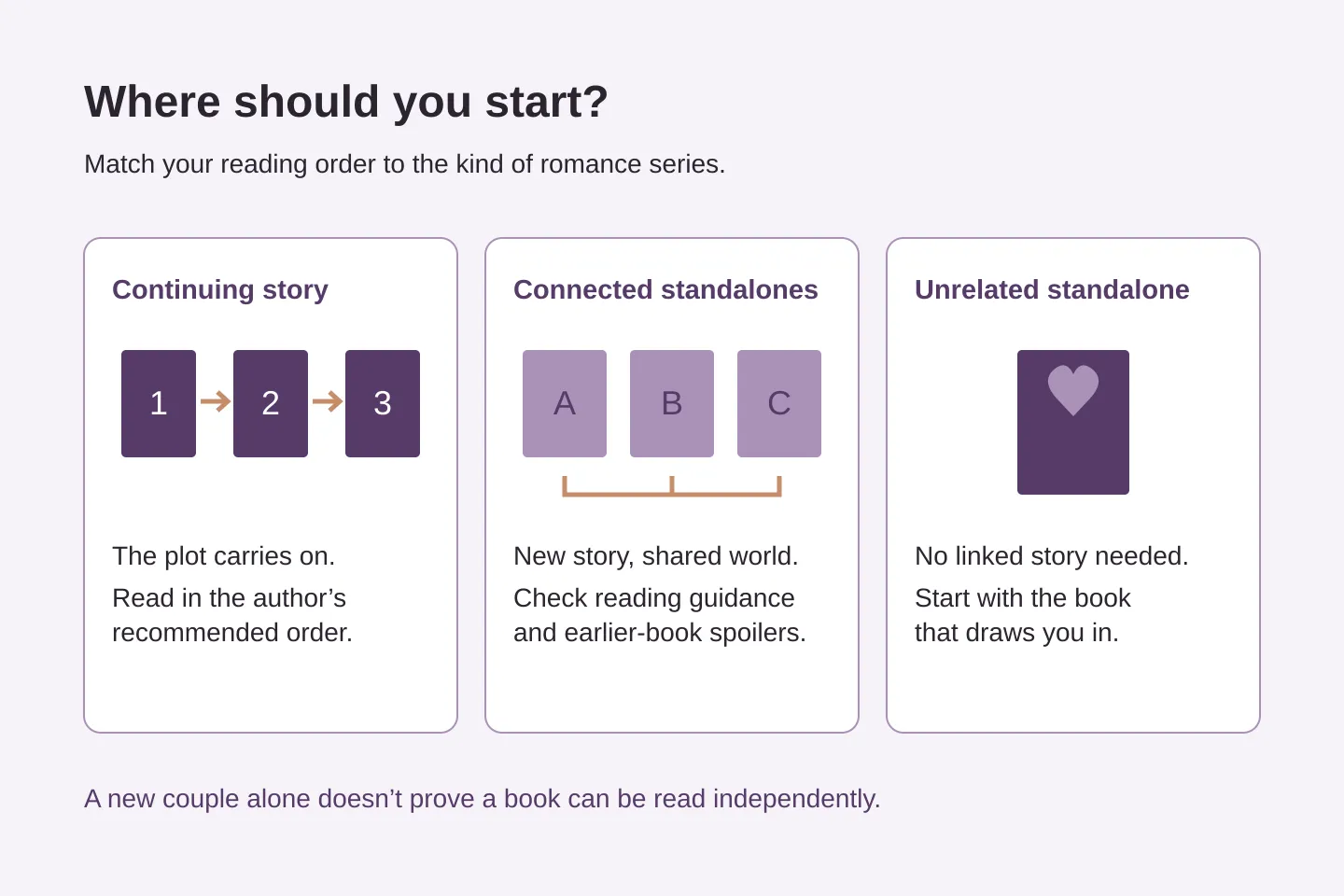
You don't always have to read romance series in order. If the books continue one relationship or an ongoing plot, follow the author's recommended sequence; if they're explicitly described as interconnected standalones, you can often start with the couple that interests you. Even an independently readable book can reveal what happened to earlier couples, so check reading guidance and your tolerance for spoilers separately.
When do you have to read romance series in order?
Read in order when a later book depends on unfinished events from an earlier one. That might mean the same couple's relationship continues across several volumes, or a wider story carries on even as the romantic leads change.
Look for wording such as “continues the story”, “must be read in order” or a warning that the book ends on a cliffhanger. A series number tells you where a book sits, but it doesn't tell you whether its central story is complete.
An author's reading guide is more useful than a guess based on the cover. Follow that guide rather than assuming release date and story chronology are the same: a prequel may have a recommended place later in the reading sequence.
What is an interconnected standalone romance?
An interconnected standalone romance is a self-contained love story that shares characters or a setting with other books. Friends, siblings or neighbours may each become the romantic leads of their own volume, while familiar couples return in the background.
Book Riot's explanation of standalone romance series distinguishes these complete individual stories from series connected by plot or character development that requires sequential reading.
Check how the author describes the particular book you're considering. “A new couple in every book” tells you whose romance takes centre stage; it doesn't, by itself, promise that you can skip all the earlier background.
| What the description says | Where to begin | What to check |
|---|---|---|
| The story continues across books | The recommended first volume | Cliffhangers and required earlier reading |
| Each book is an interconnected standalone | The recommended beginning, or the couple you prefer | Spoilers and any book-specific exceptions |
| A standalone with no linked books | That book | No series catch-up is needed |
Where to start at Hollywell Inn
For Pixie Lottie's Hollywell Inn series, start with Christmas at Hollywell Inn. BCR Publishing's Hollywell Inn series page recommends numbered order:
- Christmas at Hollywell Inn
- The Valentine Arrangement
- One Summer at Hollywell Inn
Each book introduces a new love story in the same Cotswold community. Book one begins with Emma and Jack at odds over the inn's future: she wants to save it with a Victorian Christmas festival, while he wants to cut costs and sell up.
Choose your next step:
- Try the story first: Read the free opening of Christmas at Hollywell Inn, without signing up. In about five minutes, meet the family as Evelyn's letter reveals the inn's debt and the inheritance terms that put Jack's sale plans on hold.
- Browse before reading: Explore the three Hollywell Inn books in order to see whose love story comes next. Begin your reading with book one, even if a later book's premise catches your eye.
Ask about spoilers, not just whether you'll understand it
“Can I follow this story?” and “Will it spoil an earlier book?” are different questions. A later romance can explain all the background you need while casually mentioning a previous couple's wedding, reconciliation or new home.
Ana Huang's own FAQ makes that distinction clearly. She identifies her books as interconnected standalones except for the If Love duet, so prior reading isn't necessary to understand those standalones. She still recommends reading each series in order because later instalments contain spoilers for earlier ones.
That guidance applies to her books, rather than every romance series. For another author, check their FAQ, series page or opening reading note. If you're asking a bookseller or reader group, try: “Can this book be understood on its own, and does it reveal earlier couples' outcomes? Please don't name the outcomes.”
Can you start with book three?
Say you've spotted an imagined book three about a baker and a visiting musician. Its premise appeals to you more than the first two books, and the author's guide explicitly says every volume can be read independently.
If you're comfortable meeting earlier couples after their romances have happened, start with book three. You can return to their courtships later. If you want to discover every relationship as it unfolds, begin with book one instead.
If the guide only says “a new love story”, pause before treating that as permission to skip ahead. Check for a standalone statement or an explicit recommended starting point. When guidance is missing and preserving surprises matters to you, the numbered beginning is the safer choice.